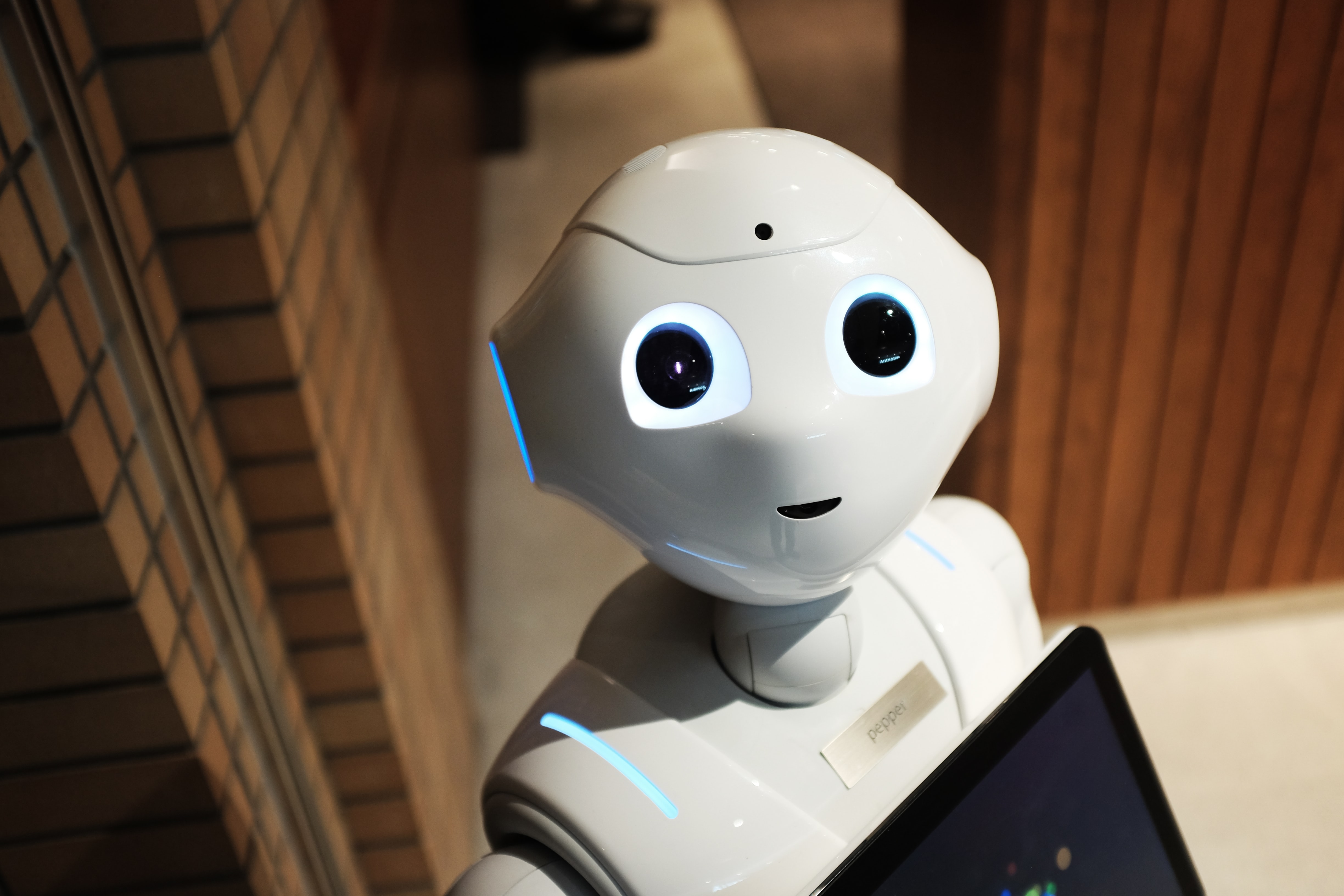
Rise of the Robots--The Future of Artificial Intelligence
In recent years the mushrooming power, functionality and ubiquity of computers and the Internet have outstripped early forecasts about technology’s rate of advancement and usefulness in everyday life. Alert pundits now foresee a world saturated with powerful computer chips, which will increasingly insinuate themselves into our gadgets, dwellings, apparel and even our bodies.Yet a closely related goal has remained stubbornly elusive. In stark contrast to the largely unanticipated explosion of computers into the mainstream, the entire endeavor of robotics has failed rather completely to live up to the predictions of the 1950s. In those days experts who were dazzled by the seemingly miraculous calculational ability of computers thought that if only the right software were written, computers could become the articial brains of sophisticated autonomous robots. Within a decade or two, they believed, such robots would be cleaning our oors, mowing our lawns and, in general, eliminating drudgery from our lives.
bviously, it hasn’t turned out that way. It is true that industrial robots have transformed the manufacture of automobiles, among other products. But that kind of automation is a far cry from the versatile, mobile, autonomous creations that so many scientists and engineers have hoped for. In pursuit of such robots, waves of researchers have grown disheartened and scores of start-up companies have gone out of business.
Robots Among Us
Read more from this special report:
Robots Among Us
It is not the mechanical “body” that is unattainable; articulated arms and other moving mechanisms adequate for manual work already exist, as the industrial robots attest. Rather it is the computer-based articial brain that is still well below the level of sophistication needed to build a humanlike robot.
Nevertheless, I am convinced that the decades-old dream of a useful, general-purpose autonomous robot will be realized in the not too distant future. By 2010 we will see mobile robots as big as people but with cognitive abilities similar in many respects to those of a lizard. The machines will be capable of carrying out simple chores, such as vacuuming, dusting, delivering packages and taking out the garbage. By 2040, I believe, we will nally achieve the original goal of robotics and a thematic mainstay of science ction: a freely moving machine with the intellectual capabilities of a human being.
Reasons for Optimism In light of what I have just described as a history of largely unfullled goals in robotics, why do I believe that rapid progress and stunning accomplishments are in the ofng? My condence is based on recent developments in electronics and software, as well as on my own observations of robots, computers and even insects, reptiles and other living things over the past 30 years.
The single best reason for optimism is the soaring performance in recent years of mass-produced computers. Through the 1970s and 1980s, the computers readily available to robotics researchers were capable of executing about one million instructions per second (MIPS). Each of these instructions represented a very basic task, like adding two 10-digit numbers or storing the result in a specied location in memory.
In the 1990s computer power suitable for controlling a research robot shot through 10 MIPS, 100 MIPS and has lately reached 50,000 MIPS in a few high-end desktop computers with multiple processors. Apple’s MacBook laptop computer, with a retail price at the time of this writing of $1,099, achieves about 10,000 MIPS. Thus, functions far beyond the capabilities of robots in the 1970s and 1980s are now coming close to commercial viability.
For example, in October 1995 an experimental vehicle called Navlab V crossed the U.S. from Washington, D.C., to San Diego, driving itself more than 95 percent of the time. The vehicle’s self-driving and navigational system was built around a 25-MIPS laptop based on a microprocessor by Sun Microsystems. The Navlab V was built by the Robotics Institute at Carnegie Mellon University, of which I am a member. Similar robotic vehicles, built by researchers elsewhere in the U.S. and in Germany, have logged thousands of highway kilometers under all kinds of weather and driving conditions. Dramatic progress in this field became evident in the DARPA Grand Challenge contests held in California. In October 2005 several fully autonomous cars successfully traversed a hazard-studded 132-mile desert course, and in 2007 several successfully drove for half a day in urban traffic conditions.
In other experiments within the past few years, mobile robots mapped and navigated unfamiliar ofce suites, and computer vision systems located textured objects and tracked and analyzed faces in real time. Meanwhile personal computers became much more adept at recognizing text and speech.
Still, computers are no match today for humans in such functions as recognition and navigation. This puzzled experts for many years, because computers are far superior to us in calculation. The explanation of this apparent paradox follows from the fact that the human brain, in its entirety, is not a true programmable, general-purpose computer (what computer scientists refer to as a universal machine; almost all computers nowadays are examples of such machines).
To understand why this is requires an evolutionary perspective. To survive, our early ancestors had to do several things repeatedly and very well: locate food, escape predators, mate and protect offspring. Those tasks depended strongly on the brain’s ability to recognize and navigate. Honed by hundreds of millions of years of evolution, the brain became a kind of ultrasophisticated—but special-purpose—computer.
ability to do mathematical calculations, of course, was irrelevant for survival. Nevertheless, as language transformed human culture, at least a small part of our brains evolved into a universal machine of sorts. One of the hallmarks of such a machine is its ability to follow an arbitrary set of instructions, and with language, such instructions could be transmitted and carried out. But because we visualize numbers as complex shapes, write them down and perform other such functions, we process digits in a monumentally awkward and inefcient way. We use hundreds of billions of neurons to do in minutes what hundreds of them, specially “rewired” and arranged for calculation, could do in milliseconds.
A tiny minority of people are born with the ability to do seemingly amazing mental calculations. In absolute terms, it’s not so amazing: they calculate at a rate perhaps 100 times that of the average person. Computers, by comparison, are millions or billions of times faster.
Can Hardware Simulate Wetware?
The challenge facing roboticists is to take general-purpose computers and program them to match the largely special-purpose human brain, with its ultraoptimized perceptual inheritance and other peculiar evolutionary traits. Today’s robot-controlling computers are much too feeble to be applied successfully in that role, but it is only a matter of time before they are up to the task.
Implicit in my assertion that computers will eventually be capable of the same kind of perception, cognition and thought as humans is the idea that a sufciently advanced and sophisticated articial system—for example, an electronic one—can be made and programmed to do the same thing as the human nervous system, including the brain. This issue is controversial in some circles right now, and there is room for brilliant people to disagree.
At the crux of the matter is the question of whether biological structure and behavior arise entirely from physical law and whether, moreover, physical law is computable—that is to say, amenable to computer simulation. My view is that there is no good scientic evidence to negate either of these propositions. On the contrary, there are compelling indications that both are true.
Molecular biology and neuroscience are steadily uncovering the physical mechanisms underlying life and mind but so far have addressed mainly the simpler mechanisms. Evidence that simple functions can be composed to produce the higher capabilities of nervous systems comes from programs that read, recognize speech, guide robot arms to assemble tight components by feel, classify chemicals by articial smell and taste, reason about abstract matters, and so on. Of course, computers and robots today fall far short of broad human or even animal competence. But that situation is understandable in light of an analysis, summarized in the next section, that concludes that today’s computers are only powerful enough to function like insect nervous systems. And, in my experience, robots do indeed perform like insects on simple tasks.
Ants, for instance, can follow scent trails but become disoriented when the trail is interrupted. Moths follow pheromone trails and also use the moon for guidance. Similarly, many commercial robots can follow guide wires installed below the surface they move over, and some orient themselves using lasers that read bar codes on walls.
If my assumption that greater computer power will eventually lead to human-level mental capabilities is true, we can expect robots to match and surpass the capacity of various animals and then nally humans as computer-processing rates rise sufciently high. If on the other hand the assumption is wrong, we will someday nd specic animal or human skills that elude implementation in robots even after they have enough computer power to match the whole brain. That would set the stage for a fascinating scientic challenge—to somehow isolate and identify the fundamental ability that brains have and that computers lack. But there is no evidence yet for such a missing principle.
The second proposition, that physical law is amenable to computer simulation, is increasingly beyond dispute. Scientists and engineers have already produced countless useful simulations, at various levels of abstraction and approximation, of everything from automobile crashes to the “color” forces that hold quarks and gluons together to make up protons and neutrons.
Nervous Tissue and Computation
If we accept that computers will eventually become powerful enough to simulate the mind, the question that naturally arises is: What processing rate will be necessary to yield performance on a par with the human brain? To explore this issue, I have considered the capabilities of the vertebrate retina, which is understood well enough to serve as a Rosetta stone roughly relating nervous tissue to computation. By comparing how fast the neural circuits in the retina perform image-processing operations with how many instructions per second it takes a computer to accomplish similar work, I believe it is possible to at least coarsely estimate the information-processing power of nervous tissue—and by extrapolation, that of the entire human nervous system.
The human retina is a patch of nervous tissue in the back of the eyeball half a millimeter thick and approximately two centimeters across. It consists mostly of light-sensing cells, but one tenth of a millimeter of its thickness is populated by image-processing circuitry that is capable of detecting edges (boundaries between light and dark) and motion for about a million tiny image regions. Each of these regions is associated with its own ber in the optic nerve, and each performs about 10 detections of an edge or a motion each second. The results ow deeper into the brain along the associated ber.
From long experience working on robot vision systems, I know that similar edge or motion detection, if performed by efcient software, requires the execution of at least 100 computer instructions. Therefore, to accomplish the retina’s 10 million detections per second would necessitate at least 1,000 MIPS.
The entire human brain is about 75,000 times heavier than the 0.02 gram of processing circuitry in the retina, which implies that it would take, in round numbers, 100 million MIPS (100 trillion instructions per second) to emulate the 1,500-gram human brain. Personal computers in 2008 are just about a match for the 0.1-gram brain of a guppy, but a typical PC would have to be at least 10,000 times more powerful to perform like a human brain.
Brainpower and Utility
Though dispiriting to articial-intelligence experts, the huge decit does not mean that the goal of a humanlike articial brain is unreachable. Computer power for a given price doubled each year in the 1990s, after doubling every 18 months in the 1980s and every two years before that. Prior to 1990 this progress made possible a great decrease in the cost and size of robot-controlling computers. Cost went from many millions of dollars to a few thousand, and size went from room-lling to handheld. Power, meanwhile, held steady at about 1 MIPS. Since 1990 cost and size reductions have abated, but power has risen to about 10,000 MIPS for a home computer. At the present pace, only about 20 or 30 years will be needed to close the gap. Better yet, useful robots don’t need full human-scale brainpower.
Commercial and research experiences convince me that the mental power of a guppy—about 10,000 MIPS—will sufce to guide mobile utility robots reliably through unfamiliar surroundings, suiting them for jobs in hundreds of thousands of industrial locations and eventually hundreds of millions of homes. A few machines with 10,000 MIPS are here already, but most industrial robots still use processors with less than 1,000 MIPS.
Commercial mobile robots have found few jobs. A paltry 10,000 work worldwide, and the companies that made them are struggling or defunct. (Makers of robot manipulators are not doing much better.) The largest class of commercial mobile robots, known as automatic guided vehicles (AGVs), transport materials in factories and warehouses. Most follow buried signal-emitting wires and detect end points and collisions with switches, a technique developed in the 1960s.
It costs hundreds of thousands of dollars to install guide wires under concrete oors, and the routes are then xed, making the robots economical only for large, exceptionally stable factories. Some robots made possible by the advent of microprocessors in the 1980s track softer cues, like magnets or optical patterns in tiled oors, and use ultrasonics and infrared proximity sensors to detect and negotiate their way around obstacles.
The most advanced industrial mobile robots, developed since the late 1980s, are guided by occasional navigational markers—for instance, laser-sensed bar codes—and by preexisting features such as walls, corners and doorways. The costly labor of laying guide wires is replaced by custom software that is carefully tuned for each route segment. The small companies that developed the robots discovered many industrial customers eager to automate transport, oor cleaning, security patrol and other routine jobs. Alas, most buyers lost interest as they realized that installation and route changing required time-consuming and expensive work by experienced route programmers of inconsistent availability. Technically successful, the robots zzled commercially.
In failure, however, they revealed the essentials for success. First, the physical vehicles for various jobs must be reasonably priced. Fortunately, existing AGVs, forklift trucks, oor scrubbers and other industrial machines designed for accommodating human riders or for following guide wires can be adapted for autonomy. Second, the customer should not have to call in specialists to put a robot to work or to change its routine; oor cleaning and other mundane tasks cannot bear the cost, time and uncertainty of expert installation. Third, the robots must work reliably for at least six months before encountering a problem or a situation requiring downtime for reprogramming or other alterations. Customers routinely rejected robots that after a month of awless operation wedged themselves in corners, wandered away lost, rolled over employees’ feet or fell down stairs. Six months, though, earned the machines a sick day.
Robots exist that have worked faultlessly for years, perfected by an iterative process that xes the most frequent failures, revealing successively rarer problems that are corrected in turn. Unfortunately, that kind of reliability has been achieved only for prearranged routes. An insectlike 10 MIPS is just enough to track a few handpicked landmarks on each segment of a robot’s path. Such robots are easily confused by minor surprises such as shifted bar codes or blocked corridors (not unlike ants thrown off a scent trail or a moth that has mistaken a streetlight for the moon).